
From August 12 to 19, 2026, Ignazio Andriolo participated in the NEPHEWS Twinning Program to conduct research at the P66 Time-resolved Luminescence Spectroscopy Beamline at PETRA III at DESY in Hamburg. Ignazio holds a master’s degree in chemistry, and started his PhD course this year at the Institute of Low Temperature and Structure Research of the Polish Academy of Sciences (INTiBS PAN) in Wrocław, Poland.
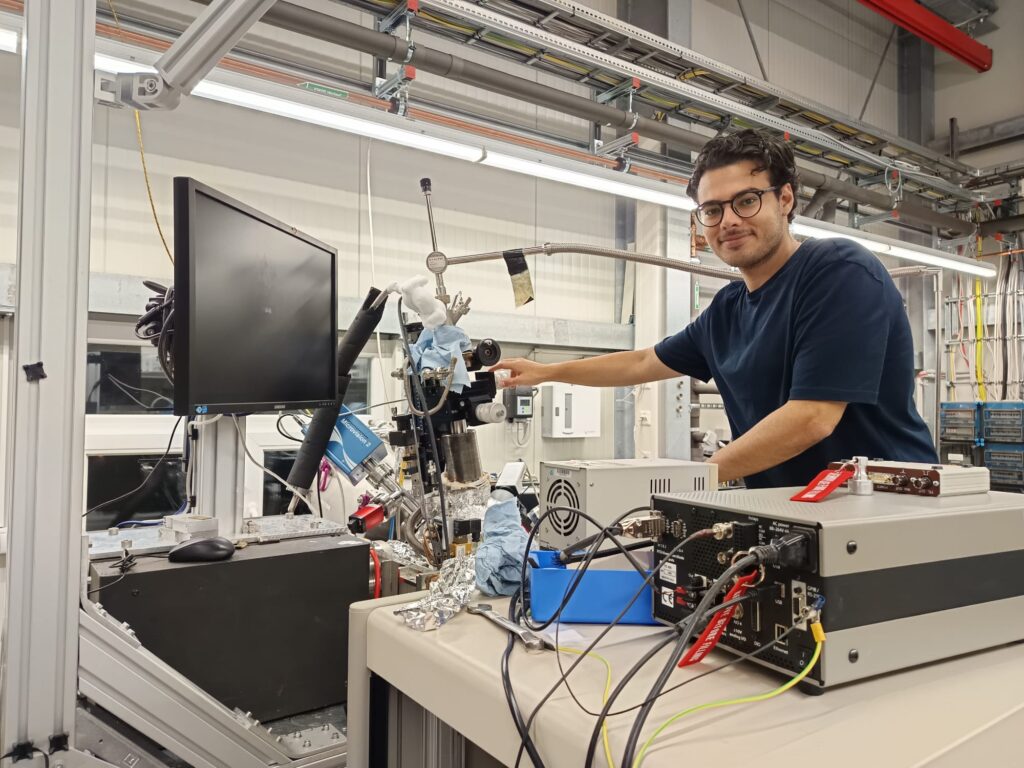
Ignazio’s research focuses on developing persistent luminescent materials based on spinels with the general formula AB2O4. “Currently, I am optimising Yb concentration in ZnGa2O4 powders to enhance afterglow properties in the near-infrared (NIR) range, which is important for subsequent use of these materials for bioimaging. Persistent luminescence is closely related to defects in the matrix, such as structural defects, oxygen vacancies, etc.” These defects can trap electrons and holes and release them over time. The host matrix used in Andriolo’s samples is a wide-band-gap semiconductor with a band gap between 4.4 and 5.0 eV. To explore the mechanisms behind persistent luminescence, band-to-band transitions are induced that promote charge carriers into trap states. This requires high-intensity excitation in the deep UV under Ultra-High Vacuum (UHV). “Operating in UHV, which is offered at beamlines P66, is essential to keep the samples uncontaminated and prevent high-energy photons from being absorbed by air”, Andriolo explains.
“As fist-time user, during my visit, I was introduced to the whole workflow of the experiment. First, I learned standard sample preparation procedures, e.g. how powdered samples are placed in copper holders achieving homogeneous surface and how to ensure effective thermal contact. Once properly prepared, the sample is inserted into the experimental chamber, and vacuum pumps are activated, achieving an ultra-high vacuum (~10-9 mbar), which takes the whole night before measurements started on the second day. The beamline staff, Dr. Oksana Chukova and Dr. Aleksii Kotlov, explained to me the instrument’s components and how synchrotron light is guided to the sample through a grating system.”
Under guidance of the Twinning Partner and co-supervisor, Dr. Vitalii Boiko, Ignazio then focused on measuring Excitation-Emission Matrices (EEMs), which are collections of sequential emission-excitation spectra recorded at increasing excitation wavelengths. “Preliminary observations from the EEM measurements in the 100–310 nm excitation range gave interesting insights,” Ingazio says. He found that the intensity of this emission correlates with the number of defects, and the number of defects (emission intensity) correlates with Yb concentration. Based on the previous analysis and the results obtained at P66, he could define an optimal concentration of Yb where both dopant emission and defect emission show good correlation.
“I sincerely thank the NEPHEWS Twinning Program for funding this training and the opportunity to measure my samples at PETRA III, as well as my supervisor and the beamline staff for their guidance and exceptional support during the experiment.”
Author: DESY Team