Key Facts
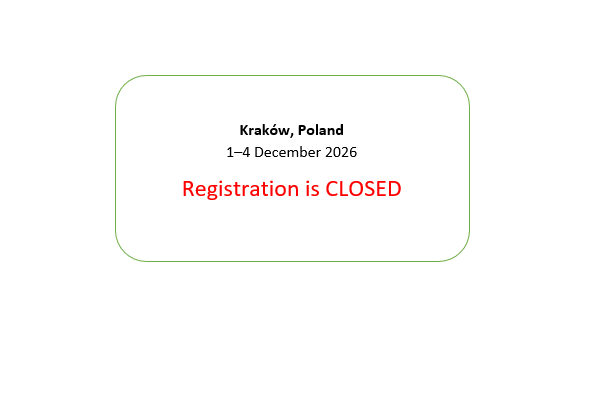
Dates: 1–4 December 2026
Location: SOLARIS National Synchrotron Radiation Centre, Kraków, Poland
Synchrotron-Based Research Methods: Theory and Practice
The workshop offered by the NEPHEWS provides a comprehensive introduction to synchrotron radiation and its application in modern research. The main objective of the training is to familiarize participants with the physical principles underlying synchrotron radiation, the range of experimental methods available at synchrotron facilities, and the practical aspects of planning and conducting synchrotron-based experiments. A key outcome of the course is to enable participants to independently prepare and submit competitive proposals for beamtime at large-scale research infrastructures.
The workshop is organized as a four-day on-site course for 24 participants, combining lectures, facility visits, and hands-on project-oriented activities.
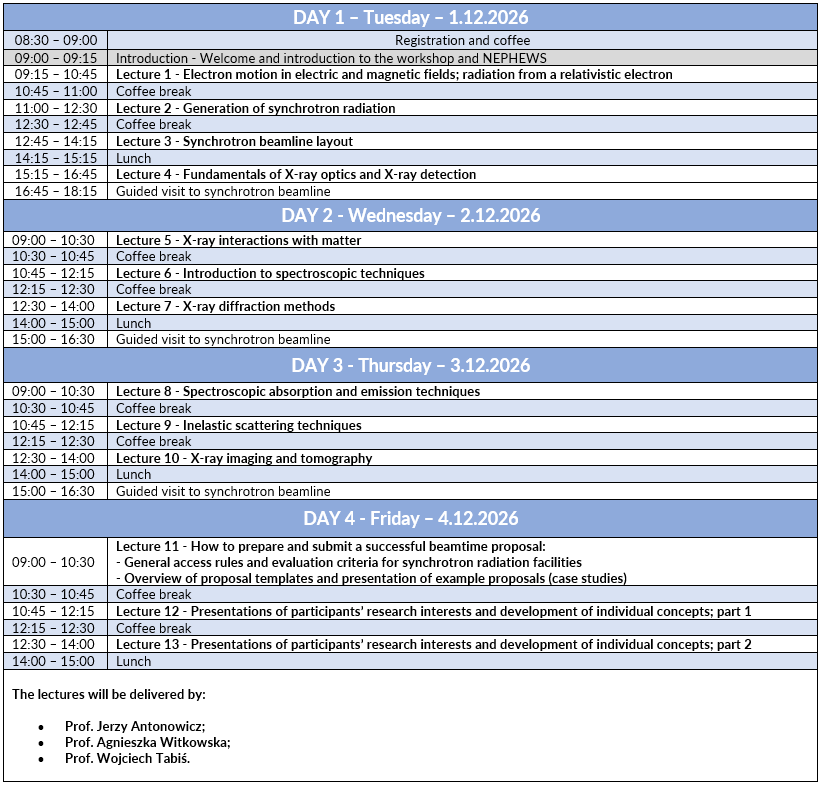
The lecture programme covers both fundamental theory and applied aspects of synchrotron and free-electron laser (FEL) science. On the first day, participants are introduced to the motion of electrons in electric and magnetic fields, radiation emitted by relativistic electrons, and the principles of synchrotron radiation generation. This is followed by an overview of synchrotron and FEL beamline layouts, fundamentals of X-ray optics, and X-ray detection techniques. The next two days focus on X-ray interactions with matter and various experimental techniques. X-ray Absorption Spectroscopy (XAS), X-ray Emission Spectroscopy (XES), photoelectron spectroscopy (PES), resonant and inelastic X-ray scattering (RIXS, IXS), X-ray diffraction methods, as well as X-ray imaging and tomography, are discussed, highlighting their applicability across physics, chemistry, materials science, and life sciences.
A distinctive feature of the training is a guided visit to synchrotron beamlines. On consecutive days, each group visits a different type of beamline available at the SOLARIS synchrotron, dedicated to a specific experimental technique, e.g. X-ray absorption spectroscopy (XAS), photoelectron spectroscopy (PES) and X-ray imaging/tomography. During these visits, participants learn about beamline components, experimental geometries, sample environments, data acquisition, and common experimental constraints.
The fourth day is dedicated to project-oriented training focused on access to synchrotron and FEL facilities. Participants receive detailed guidance on general access rules and evaluation criteria for synchrotron beamtime proposals. The structure of proposal templates is discussed, supported by selected case studies of successful applications. Participants then present their scientific interests and research challenges and work together with experienced users of synchrotron radiation to develop the initial concept of their own synchrotron or FEL experiment.
Following the on-site training, participants enter a two-week individual project phase, during which they prepare a complete beamtime proposal for a selected synchrotron beamline. This phase is supported by two online consultation meetings.
The NEPHEWS Photon Workshop thus combines theoretical foundations, practical insight, and proposal-writing skills, providing participants with the competence required to effectively use large-scale X-ray facilities in their future research.
The programme is open only to PhD candidates and students enrolled in second-cycle Master’s degree programmes.
Applicants are required to complete an online application form, which includes:
In addition, applicants are required to submit a recommendation letter from their supervisor.
For detailed information, please see the REGISTRATION section below.
Participation restrictions
Opening of the call for applications: 17 September 2026
|
Application deadline: 16 October 2026 (23:59 CET)
|
Announcement of results: 6 November 2026
|
Submitted applications will first undergo a formal eligibility check conducted by the project coordinator’s team. Only complete applications, consisting of the online application form and the recommendation letter from the supervisor, will be considered for evaluation.
Eligible applications will then be evaluated from a scientific and substantive perspective by a panel of experts composed of workshop instructors and representatives of the project partners.
The evaluation process will take into account the following criteria:
In cases where two or more applications receive the same evaluation score, geographical priority will be used as a tie-breaker.
Geographical priority points are used only to resolve ties and do not form part of the initial evaluation score.
If the geographical priority criteria do not resolve the tie, priority will be given to the applicant who received the higher score in Motivation and relevance of participation.
The organiser (SOLARIS) will provide financial support to cover eligible travel and accommodation costs for selected participants attending the workshop.
The support will cover:
Travel and Accommodation Reimbursement
Personal data collected during the recruitment process will be processed solely for the purposes of organising and conducting the selection procedure, managing participation in the workshop, and fulfilling the project’s reporting obligations.
The processing of personal data will be carried out in accordance with applicable data protection regulations, including the General Data Protection Regulation (GDPR).
Applicants’ personal data and submitted documents will be accessible only to authorised persons involved in the recruitment process and the organisation of the workshop. Personal data will not be publicly disclosed or shared with third parties, except where necessary for project implementation, reporting obligations, or compliance with legal requirements.
By submitting an application, applicants acknowledge that they have read the information regarding the processing of their personal data available in the Privacy Policy.
Only complete applications, including the online registration form and the recommendation letter, will be considered for evaluation.
Please submit your application by 16 October 2026 (23:59 CET).
Scan the QR or use link to join