
The NEPHEWS project supports knowledge exchange through research visits by early-stage researchers to European user facilities.
In October 2026, PhD student Chrysi Giannitsa completed a research visit to the ELBE Center for High-Power Radiation Sources at Helmholtz-Zentrum Dresden-Rossendorf (HZDR), Germany.
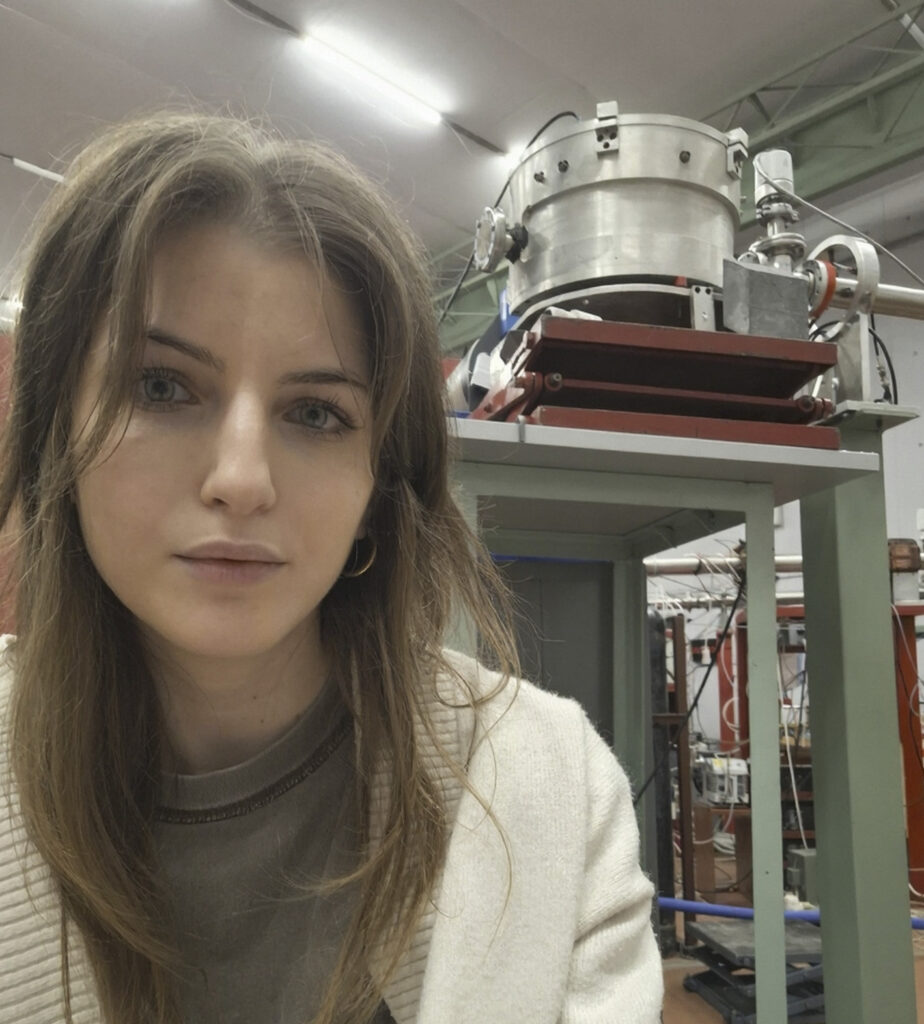
Chrysi comes from the National and Kapodistrian University of Athens, Greece. She is an experimental physicist with a background in Chemistry, Physical Chemistry and Radiochemistry, conducting doctoral research on nuclear clustering phenomena and reaction dynamics in heavy-ion collisions. Her visit to HZDR provided an opportunity to explore accelerator-based THz radiation and its applications in ultrafast spectroscopy.
During her stay at the ELBE facility, Chrysi joined the beamtime of an external team that welcomed her to their experiments. Discussions and an exchange of expertise provided her with valuable insight into THz physics and the experimental methods used to characterize the radiation and prepare the detection system.
“During my stay at the ELBE facility at HZDR in Dresden, I had the opportunity to learn about cutting-edge experiments using intense THz radiation. I gained insight into how accelerator-driven THz pulses are generated, directed, and controlled using specialized optics, such as parabolic mirrors, reflective components, and polarization optics, and how they are synchronized with femtosecond lasers to probe ultrafast phenomena. Coming from a chemistry background, I was particularly fascinated by the material composition and dynamical response of the metamaterial sample, specifically the band structure of InSb that enables dynamic effective mass modulation and time-crystal behavior. Both the TELBE facility team and the visiting scientists from École Polytechnique were exceptionally supportive, patient, and welcoming, taking the time to explain not only the specific plasmonic metamaterial time-crystal setup, but also other experimental stations across the facility, making connections to physical concepts that enriched my scientific perspective.”
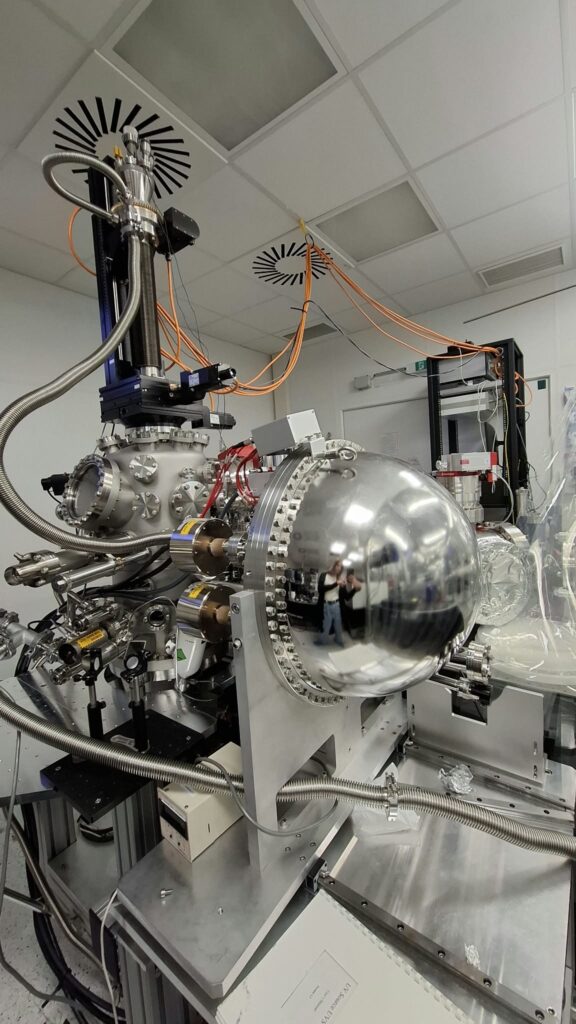
The visit enabled Chrysi to:
The visit also introduced her to a method for probing sub-picosecond material dynamics and coherent light–matter coupling. From her perspective as a chemist, this prompted her to reflect on how non-equilibrium material properties and sub-cycle charge dynamics in semiconductors can bridge the gap between chemical structure and fast photonic control. Furthermore, it inspired her to consider how advanced accelerator-based photon diagnostics and ultrafast timing schemes can offer new ideas for particle identification and radiation detection systems in nuclear research.
Reflecting on the experience, Chrysi said:
“This visit was an important step in my development as a researcher. I am truly grateful to have met such exceptional researchers who are outstanding experts in their fields, and I am deeply grateful for their kindness, guidance, and continuous support throughout the experiments. The experience immersed me in an inspiring, multidisciplinary environment at HZDR, broadened my perspective on accelerator technologies and light–matter interactions, and truly demonstrated how diverse scientific fields can enrich each other through open collaboration.”
The NEPHEWS project supports the next generation of researchers by facilitating access to state-of-the-art user facilities across Europe.