
From 14 to 18 September 2026, Prof. Svitlana Mikhaylivna Kalenska and Prof. Olha O. Kravchenko from the National University of Life and Environmental Sciences of Ukraine (NUBIP), Kyiv, visited Kraków to strengthen scientific links and explore new opportunities for collaboration.
Their programme included participation in the Joint Meeting of PSRS Members and SOLARIS Centre Users (JMSU 2026), held on 14–16 September, and the Crosscarpatian Synchrotron School (CSS2026), held at the SOLARIS National Synchrotron Radiation Centre on 16–19 September.
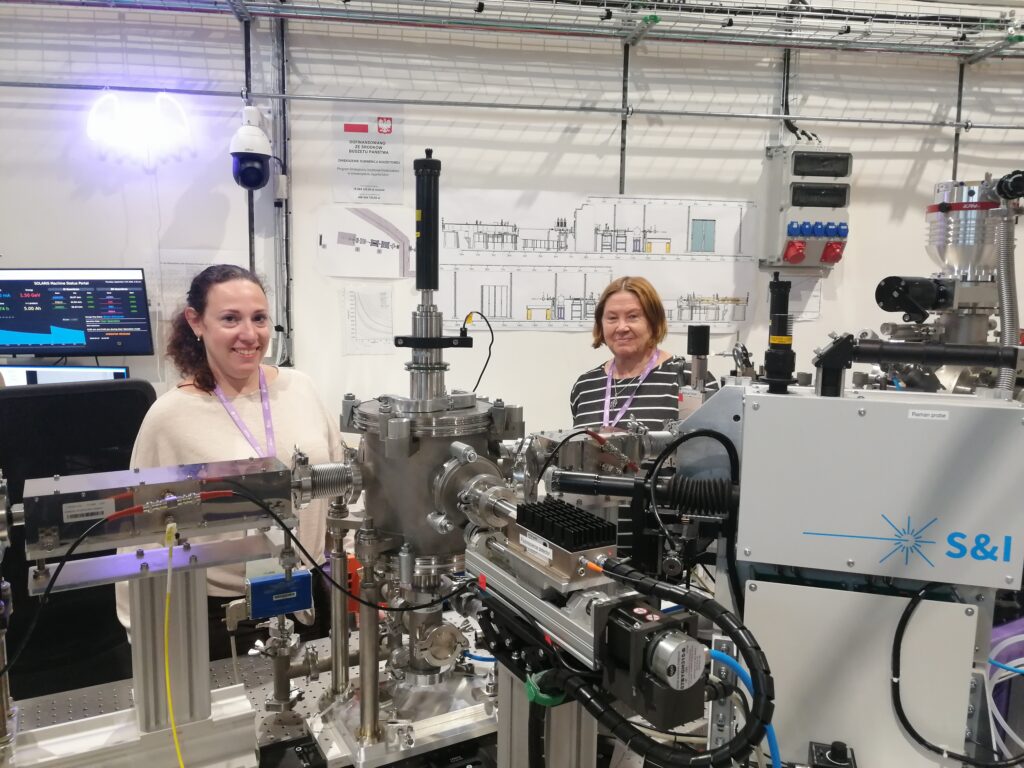
During JMSU 2026, the researchers attended presentations showcasing studies conducted by users of different SOLARIS beamlines. They also presented two posters highlighting the potential contribution of synchrotron techniques to research on nanofertilizers, crop productivity and plant responses to environmental stress.
The first poster, Nanotechnology in Crop Production, was presented by Prof. Svitlana Kalenska together with N. Novytska, R. Sonko, L. Garbar, L. Honchar, B. Mazurenko, V. Kalenskyi, O. Shutiy, V. Pylypenko, T. Antal and R. Kovalenko. It summarized more than 15 years of research conducted by the Department of Crop Production at NUBIP Ukraine on the multifunctional effects of nanopreparations on crop growth, yield formation, product quality, nutrient uptake, seed quality and plant resistance to stress and pathogens. The presented findings showed that the partial replacement of conventional mineral fertilizers with nanofertilizers could improve nutrient-use efficiency and support stable yields. The authors emphasized that high-precision synchrotron methods could help characterize nanopreparations and determine their effects on the composition and quality of plant materials.
The second poster, Innovative Nanoaquachelate Nanofertilizers Improve Photosynthetic Performance, Redox Homeostasis and Productivity of Helianthus annuus L., was presented by Prof. Olha Kravchenko together with Viacheslav Chobotar and Nadiia Yashchuk. It reported field experiments conducted in the Kyiv region during 2024–2025 using Cu–Zn and S–Se–I nanoaquachelates, applied separately or in combination with an organo-mineral fertilizer, to sunflower plants. The combined treatments improved photosynthetic performance, supported balanced antioxidant responses and increased sunflower productivity. Under drought conditions in 2024, the NChel Cu–Zn and organo-mineral fertilizer treatment increased yield by 30.3% compared with the control; in 2025, the combined NChel Cu–Zn, NChel S–Se–I and organo-mineral fertilizer treatment produced a 22.3% increase. The combined treatment also increased seed oil content by 6.8% compared with the untreated control. Future synchrotron X-ray fluorescence microscopy and X-ray absorption spectroscopy studies were proposed to determine the localization and chemical speciation of nanoaquachelate-derived micronutrients and clarify their roles in nutrient uptake and redox regulation.
The poster sessions enabled discussions with SOLARIS users and scientists about applying synchrotron radiation to agricultural, environmental and life-science research conducted at NUBIP. Particular attention was given to XAS, synchrotron XRF microscopy and tomography as complementary tools for investigating the composition, distribution and chemical forms of nutrients and nanomaterials in plants.
At CSS2026, Prof. Kalenska and Prof. Kravchenko participated in theoretical lectures and practical training. The school focused on X-ray spectroscopy and microscopy and combined introductory lectures, proposal-writing training and hands-on activities at SOLARIS beamlines. A workshop at the ASTRA beamline, led by Dr Przemysław Dzięgielewski and Prof. Jerzy Antonowicz, gave the visitors practical insight into X-ray absorption spectroscopy (XAS) and inspired ideas for applying advanced synchrotron methods—including XAS—to their research.
Discussions with Dr Alexey Maximenko, ASTRA Beamline Coordinator and the Director’s Representative for Scientific Collaboration, introduced the visitors to SOLARIS research initiatives and access opportunities, including NEPHEWS and RIANA.
NEPHEWS provides access to leading European neutron, synchrotron and free-electron-laser research infrastructures and specifically supports new and non-expert user communities, including researchers from Ukraine. These conversations also initiated the preparation of several beamtime proposals for the SOLARIS Autumn Call, whose standard submission deadline is 1 October.
On Friday, 18 September, the visitors met Prof. Maciej Guzik at the Jerzy Haber Institute of Catalysis and Surface Chemistry of the Polish Academy of Sciences, where he presented the Bioprocess Development Laboratory. They also met Prof. Marcin Niemiec from the University of Agriculture in Kraków. The discussions focused on future scientific collaboration, participation in the Agro&Food Hub currently being developed at SOLARIS, and opportunities to prepare and participate in joint European projects.
The visit created a strong foundation for further cooperation between NUBIP, SOLARIS and Kraków-based research institutions. It connected expertise in crop production, nanotechnology and environmental science with advanced synchrotron techniques and resulted in concrete plans for joint proposals and future research activities.