
Dr Furkan Işık, a researcher at the Institute of Accelerator Technologies of Ankara University, participated in the NEPHEWS Twinning Programme at the Turkish Accelerator and Radiation Laboratory (TARLA) in Ankara. During the programme, he received training on the facility’s scattering-type scanning near-field optical microscope (s-SNOM) and its nano-FTIR spectroscopy capabilities.
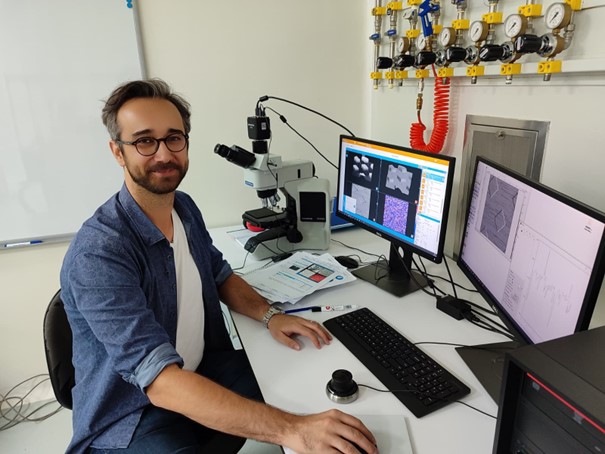
Dr Işık’s research focuses on colloidal semiconductor nanocrystals, particularly colloidal quantum wells, also known as nanoplatelets, and their applications in light-emitting diodes, photodetectors, nanolasers, and luminescent solar concentrators. His work includes heterostructure engineering, orientation-controlled self-assembly, and characterisation using ultrafast transient absorption spectroscopy, gain measurements, and electroluminescence analysis. These ensemble techniques typically provide information averaged over millions of particles. In contrast, near-field infrared microscopy enables chemical and optical characterisation with a spatial resolution of approximately 10–20 nanometres, determined primarily by the radius of the probe tip rather than the wavelength of the incident light.
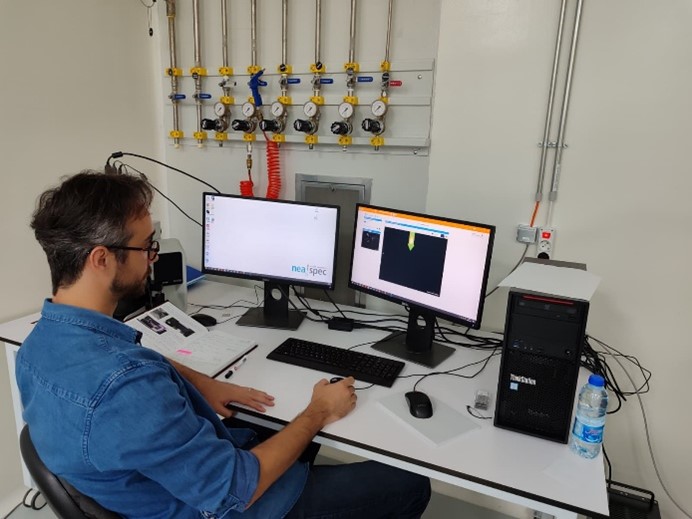
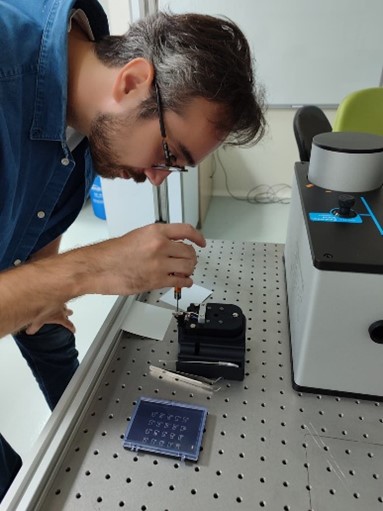
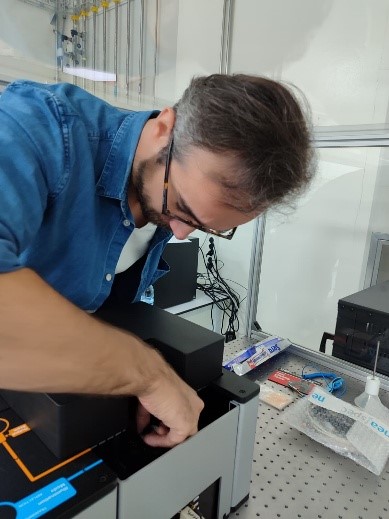
The SNOM (Scanning Near-Field Optical Microscope), described by TARLA as the only instrument of its kind in Türkiye, is part of a research infrastructure centred around a 40 MeV superconducting electron linear accelerator. TARLA’s free-electron laser is planned to cover the 5–350 micrometre wavelength range through two undulator beamlines. The combination of this infrared source with near-field detection is of particular interest for investigating low-energy excitations at the nanoscale.
Dr Işık successfully completed the training on the operation and use of the SNOM and became a trained user of the instrument.
Author: TARLA Team