
On 11–12 May 2026, scientists from Riga Technical University, Elizabete Skrebele and Jurijs Dehtjars, visited the National Synchrotron Radiation Centre SOLARIS and the PHELIX beamline within the NEPHEWS Twinning Program.
During their visit, the Latvian researchers not only had the opportunity to visit several beamlines operating at the National Synchrotron Radiation Centre SOLARIS and learn about their research capabilities, but also conducted experiments at the PHELIX beamline as part of a test experiment under the supervision of Dr Tomasz Sobol, beamline scientist at PHELIX.
The aim of the experiment was to investigate changes in the electronic structure of a semiconductor material under very high-temperature conditions exceeding 500°C. Continuous XPS measurements were performed from room temperature up to 560°C. The observed changes in the electronic structure of the material, occurring at specific temperatures, will provide the Riga researchers with valuable insight into electron transport processes in the investigated materials.
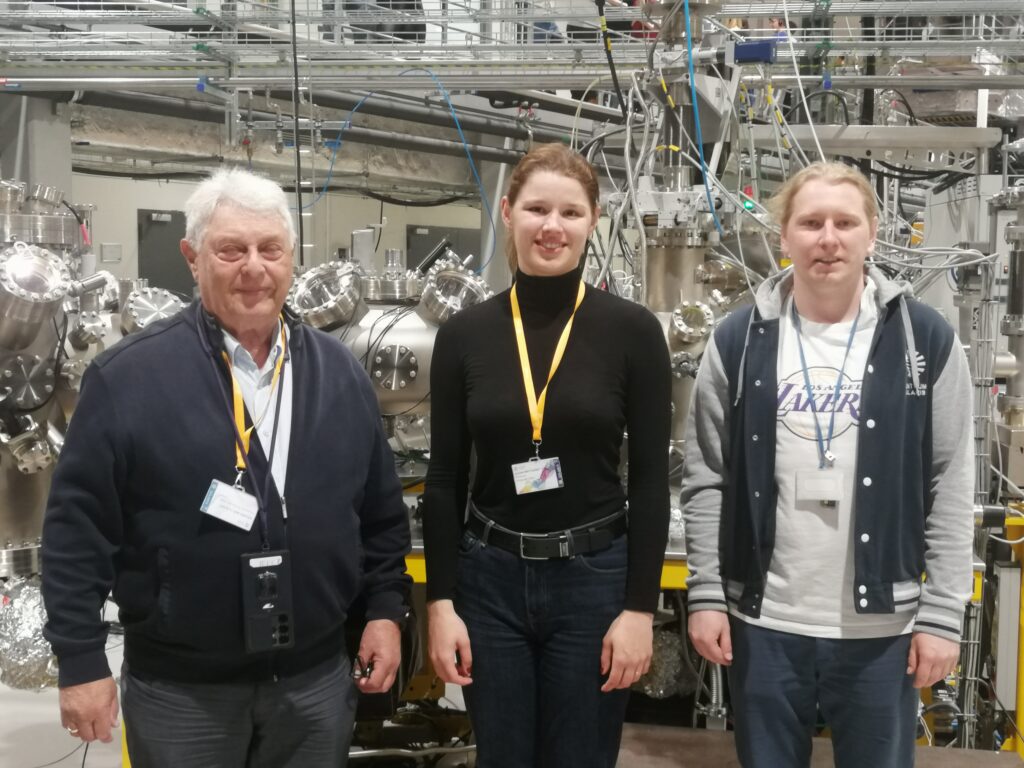
When asked about the main goal of the experiment, Jurijs Dehtjars and Elizabete Skrebele explained:
“To do measurements of Si2s spectral lines and XPS of monocrystalline silicon, using the synchrotron radiation depending on the sample heating temperature from 30 to roughly 560°C at PHELIX beamline.”
Reflecting on how the experiment supports their broader scientific objectives, Jurijs Dehtjars noted:
“The measurements are expected to clarify the exoelectron emission phenomenon to be exploited for the detection of single defects in a nanolayer of semiconductor crystals.”
This highlights the potential long-term impact of the work, particularly in the context of advanced defect detection in semiconductor systems.
When asked about the most interesting or rewarding aspects of the experiment, Jurijs pointed to clear spectroscopic effects observed during heating:
“The heat-induced shift of the Si and O XPS lines, and reconfiguration of the low-energy density of states.”
Beyond the experimental outcomes, both researchers emphasised the broader value of their stay at SOLARIS.
Jurijs Dehtjars reflected on the scientific environment and interactions with staff:
“Understanding in more detail the design and exploitation of XPS station. Personnel: Very friendly and open, answering ‘stupid’ questions, readiness to help. Thank you!”
Elizabete Skrebele added a broader reflection on both technical learning and collaboration:
“It was very useful and interesting to explore the technical details of the XPS station, vacuum chamber design and different heating elements/ techniques used in different vacuum levels. I want to express my deepest gratitude to Tomasz Sobel for the very welcoming visit and stay at the SOLARIS since the very first email written, his time spent in various online meetings and open-mind! It was a great pleasure to be part of scientific discussions evidenced by the capacity of the instrument and collaborate with the PHELIX team, beginning with sample mount, degassing of samples and recording of the last measurement.”
The support provided by the SOLARIS team was highlighted as a key element of the success of the visit.
Elizabete Skrebele stated:
“Support was brilliant since the very beginning. During our stay at PHELIX it was the same, namely, all the necessary discussions and any kind of support in the lab were provided. I highly appreciate this experience and want to warmly thank Tomasz and the PHELIX team!”
This continuous support ensured smooth and effective scientific exchange throughout the visit.
Finally, both researchers shared their views on initiatives such as the NEPHEWS Twinning Programme.
Jurijs Dehtjars commented: „Very good tool. In particular for young researchers.”
Elizabete Skrebele expanded on the broader value of such initiatives:
“I see this as an amazing opportunity not only for experienced professionals, but also for young researchers who want to test whether their ideas and experiments are feasible. These initiatives create a “win-win” situation for both researchers and research facilities by encouraging the exploration of new ideas and supporting the development of international collaborations, strengthening the global research community.”
The visit of Elizabete Skrebele and Jurijs Dehtjars to the National Synchrotron Radiation Centre SOLARIS demonstrated the strong scientific value of the NEPHEWS Twinning Programme. It fostered international collaboration and provided meaningful training opportunities in synchrotron-based techniques, contributing to both immediate research goals and future scientific development.