
As part of the Twinning programme, participants have the opportunity to gain hands-on experience at MAX IV beamlines by working with experienced research groups performing their experiments, or with beamline scientists who help explore the capabilities of the instruments during scheduled experiments performed by MAX IV postdocs and staff.
As an alternative to Twinning with experienced users, the MAX IV team provides the opportunity to gain practical skills through access to the instrumentation in Fast Access mode. This mode allows preparatory experiments and practical training with the participant’s own samples under the guidance of experienced beamline staff. Fast Access is particularly valuable for early-career researchers who are beginning to work with synchrotron techniques.
One candidate of the Twinning programme took advantage of this opportunity by visiting MAX IV. Below is the report from a young scientist, Ville Nenonen, who gained practical experience at the Softimax beamline.
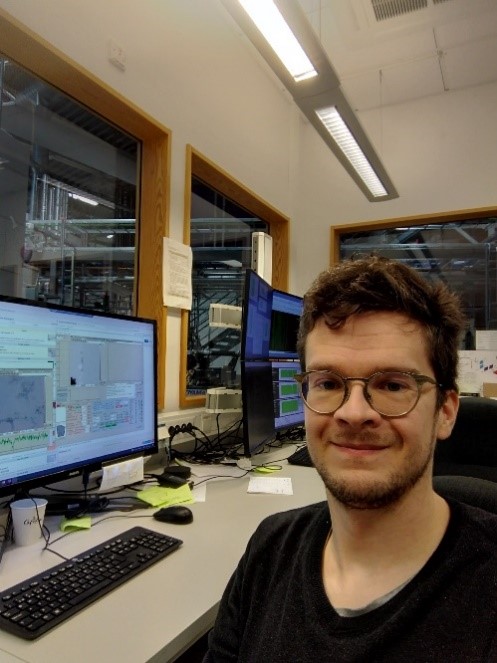
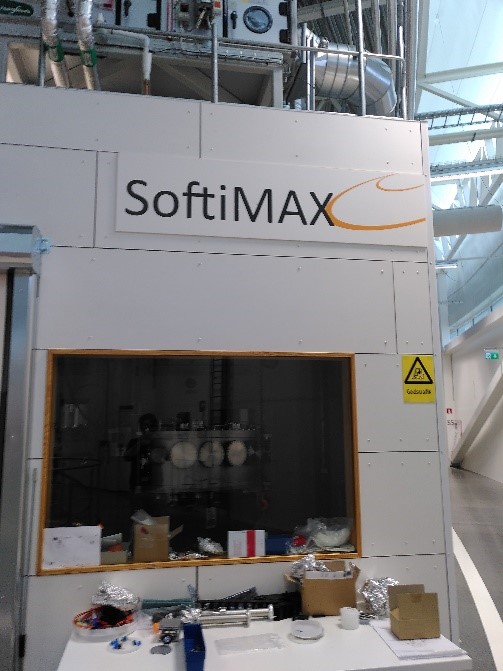
Report by Ville Nenonen
My name is Ville Nenonen. I am an environmental geochemist and currently work as a postdoctoral researcher at the University of Helsinki, Finland. As part of the Twinning programme, I had the opportunity to visit the MAX IV facility at the Softimax beamline to receive training and perform preparatory experiments on Fe-Ca-OM coprecipitates. These precipitates exhibit heterogeneity on the nanoscale and form in natural redox boundaries in soils and waters, playing a critical role in controlling the fate and mobility of carbon, nutrients, and contaminants.
The primary goal of my visit was to gain hands-on experience with Scanning Transmission X-ray Microscopy (STXM), a technique that allows chemical mapping of samples at very small scales. Under the guidance of the beamline scientists, I performed measurements at two distinct X-ray energy regions:
The spatial and spectral resolution offered by the Softimax beamline is essential for characterizing these samples. The resulting data will allow us to get more information on the binding of carbon together with Fe and Ca, providing insights into carbon cycling.
I am grateful to the MAX IV staff, especially Karina Thånell, for welcoming me and showing expert support during the beamtime and to the NEPHEWS project for providing access to the beamline.