
From 20 to 26 May 2026, Martin Labuda, a PhD student at the Institute of Molecular Biology of the Slovak Academy of Sciences, took part in the NEPHEW Twinning Programme at European XFEL. During his visit, he joined an external user experiment from the University of Gothenburg, participating in the beamtime campaign carried out from 22 to 25 May 2026 at the SPB/SFX instrument under the scientific support of Dr. Tokushi Sato, European XFEL local scientist.
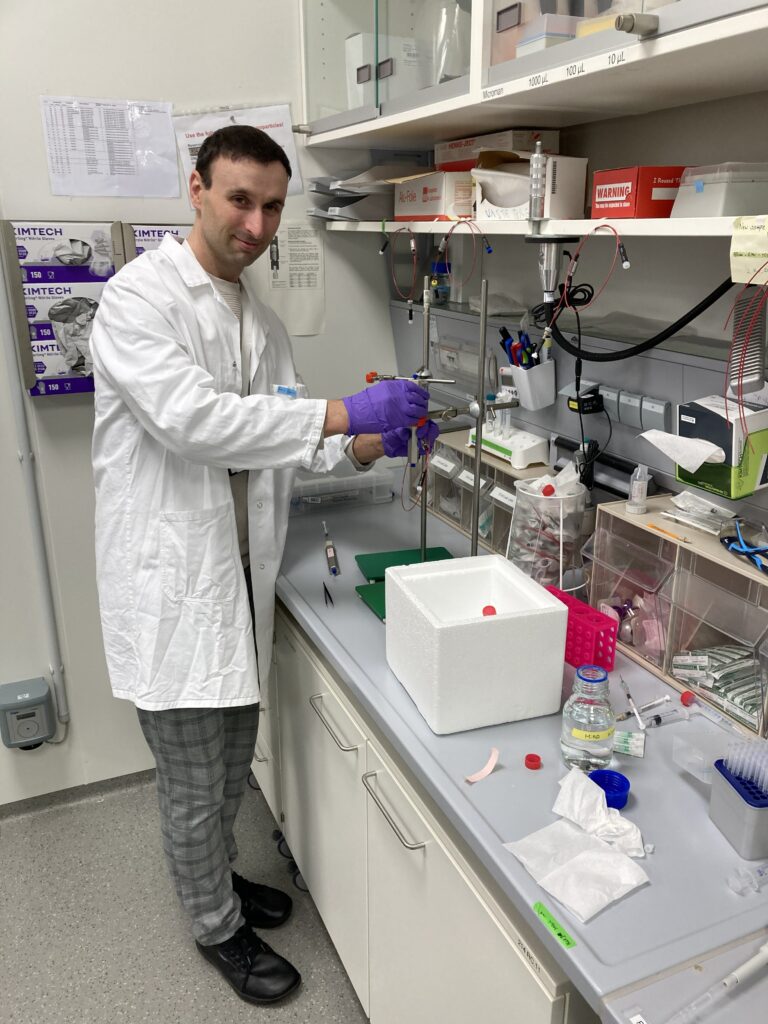
Martin’s research focuses on understanding how phosphorylation influences protein properties and structure, particularly proteins involved in mitochondrial homeostasis. While he had previously worked on protein structure determination using X-ray crystallography, the NEPHEW Twinning Programme offered his first opportunity to participate directly in an XFEL beamtime experiment.
The experiment explored advanced approaches for investigating protein structural dynamics using X-ray free-electron laser radiation, bringing together researchers from several European institutions in a highly collaborative environment.
Reflecting on his experience, Martin highlighted that participating in the complete beamtime workflow was one of the most valuable aspects of the visit. Beyond the scientific measurements, he gained practical experience in experimental planning, coordinating sample preparation with instrument operation, adapting to changing experimental conditions, and working as part of an international research team.
„The Twinning Programme allowed me to participate directly in a beamtime experiment, something I had not experienced before,” Martin said. „It helped me understand the complete workflow, from sample preparation to data collection, while learning from researchers with complementary expertise.”
Martin believes the experience will directly benefit his research at the Institute of Molecular Biology of the Slovak Academy of Sciences. Exposure to state-of-the-art XFEL methodologies has broadened his perspective on studying protein structural dynamics and opened new opportunities for future collaborations.
By connecting researchers from widening countries with world-class facilities and international user teams, the NEPHEW Twinning Programme strengthens scientific excellence, promotes knowledge transfer, and helps develop the next generation of scientists capable of exploiting advanced photon science infrastructures.
European XFEL is pleased to support these exchanges and looks forward to welcoming more Twinning participants in the future.
Author: European XFEL