
Elettra Sincrotrone Trieste recently welcomed Jakub Kušnír from the Institute of Thermomechanics of the Czech Academy of Sciences in Prague for a week stay within the framework of the NEPHEWS Twinning Programme, currently hosted at the FERMI beamlines.
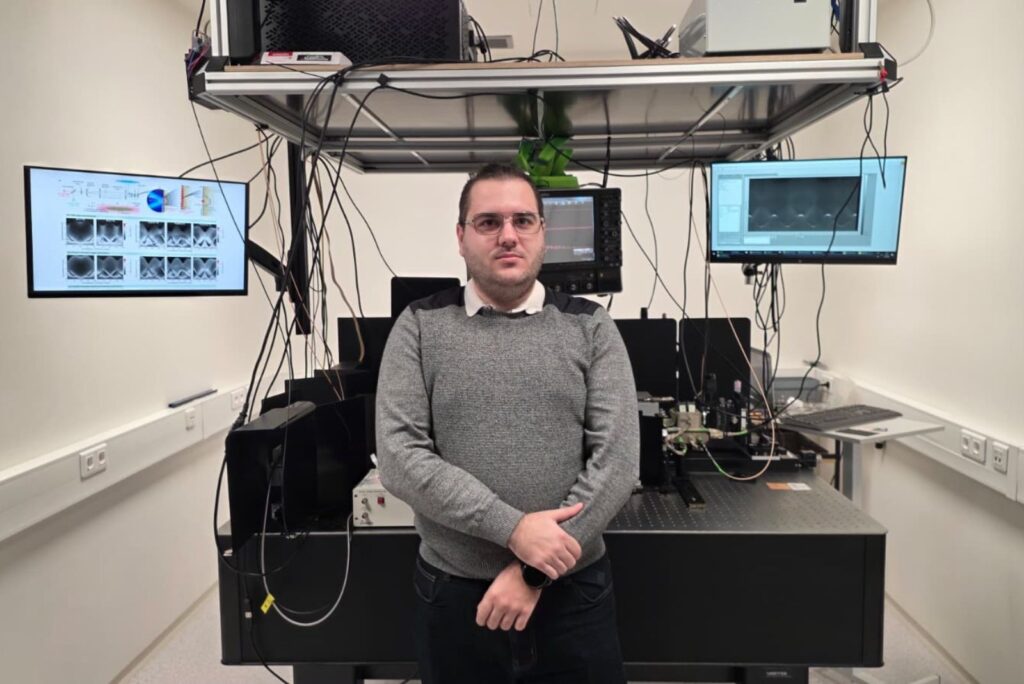
The Twinning Programme, part of the broader NEPHEWS initiative, aims to promote the transfer of key competences required to operate successfully within large-scale research infrastructures. By pairing early-career researchers with experienced beamline teams, the programme offers hands-on participation in ongoing experiments, fostering both technical expertise and a deeper understanding of facility-based research.
Jakub conducts research using optical transient grating spectroscopy (TGS) at a wavelength of 10 µm, focusing on NiMnGa-based alloys and Co–Cr–(Ga,Si) Heusler alloys that exhibit the magnetic shape memory effect. These materials are of particular scientific interest because their lattice stability is strongly mediated by magnetism: the magnetic order directly influences the stability of specific structural phases.
While acoustic and thermal properties of these alloys can be effectively investigated using conventional laboratory TGS systems, the study of magneto-structural dynamics driven by rapid magnetic fluctuations requires much shorter excitation wavelengths and access to significantly higher frequency ranges. Such capabilities are uniquely available at FERMI, where transient grating techniques have been extended to short-wavelength excitation and THz-range dynamics through advanced pump–probe approaches.
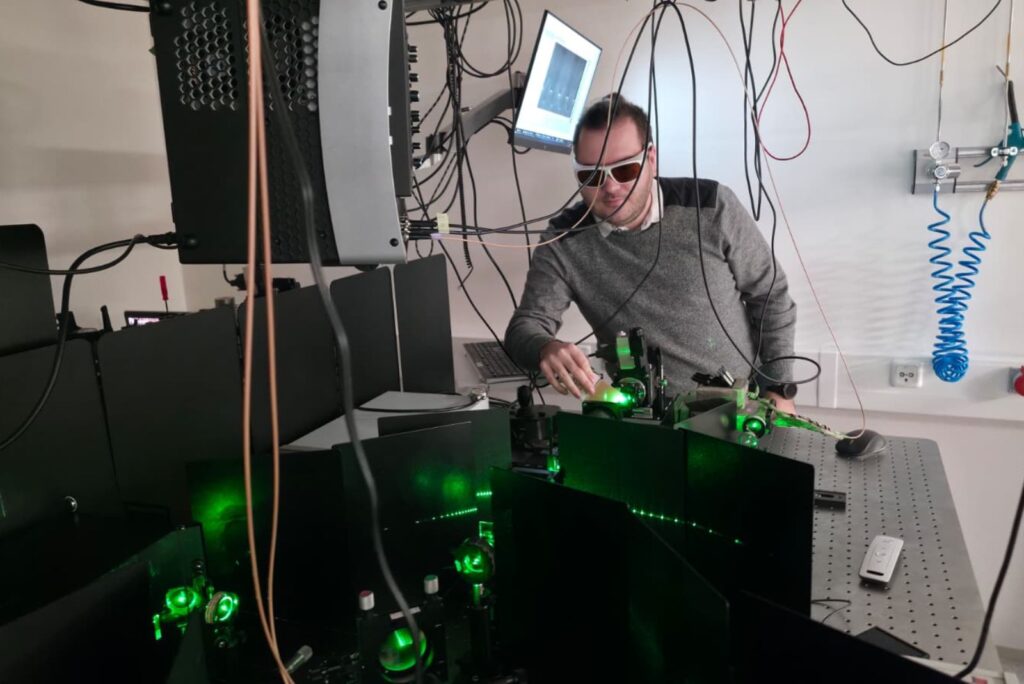
During his stay, Jakub expanded his knowledge of pump–probe transient grating methodologies and explored the measurement of magnetic properties using TG techniques under free-electron laser conditions. The experience provided valuable insight into the experimental design required for short-wavelength transient grating studies and strengthened his ability to plan future measurements of his materials at FERMI.
His visit proved both scientifically enriching and strategically important, equipping him with the expertise needed to prepare a competitive beamtime proposal and further develop his research on magnetically driven structural phenomena. For Elettra and FERMI, hosting motivated researchers such as Kušnír confirms the importance of the Twinning Programme in building strong scientific connections and supporting the next generation of facility users.
Author: ELETTRA Team