
The NEPHEWS project is designed to strengthen scientific excellence, foster international collaboration, and enable access to leading European research infrastructures through dedicated support programmes such as Transnational Access (TNA) and Early-Stage Researcher (ESR) schemes. A compelling example of this mission in action is the recent visit of experienced and early-stage scientists to the SOLARIS Light Source, where cutting-edge synchrotron experiments were carried out on the ASTRA and PIRX beamlines.
This success story presents the visit primarily through the voices of the researchers themselves, complemented by a narrative context describing the role of NEPHEWS. It highlights how NEPHEWS enables both high-impact research and meaningful knowledge transfer across borders, disciplines, and career stages.
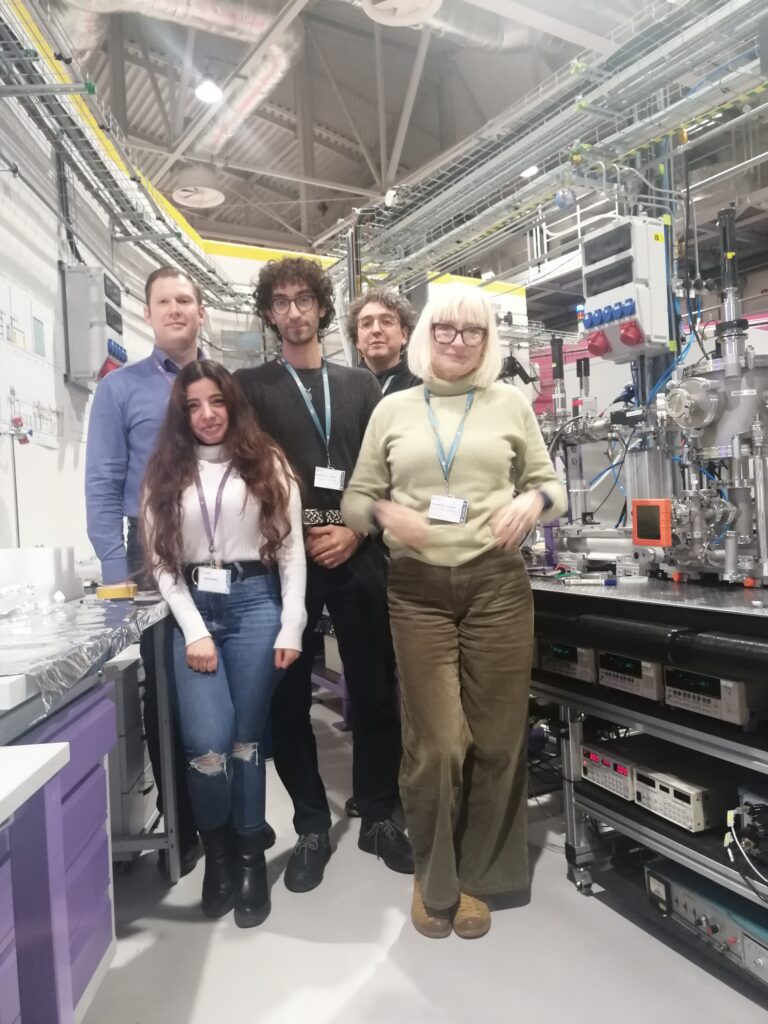
Alexey Maximenko (SOLARIS), Lulu Alluhaibi (SOLARIS), Georgios Charalampopoulos, Teresa J. Bandosz, and Marc Florent at the ASTRA beamline
Visiting scientists:
During their stay at SOLARIS, the researchers performed experiments on two beamlines, ASTRA and PIRX, as part of two complementary studies:
Titles of the experiments:
As described by the visiting scientists:
Their research addresses key challenges in the development of sustainable and cost-effective energy technologies, particularly the search for alternatives to platinum-based catalysts for fuel cells. As described by the researchers:
„Our work at Solaris Light Source focused on the XAS characterization of various carbon-based catalysts, with an aim to investigate the surface chemical environments of incorporated transition metals (Cu, Fe, Co) and S, N and O ligands. To prepare those materials, we followed a specific synthesis path in which sulfur-rich commodity polymers were carbonized at specific conditions in the presence of nitrogen and metal precursors. This approach resulted in the catalysts of remarkable activity for oxygen reduction reactions, crucial for fuel cells.”
This line of research directly responds to the growing demand for affordable and efficient catalytic materials and highlights the broader societal relevance of the work supported by NEPHEWS.
„In this line of research, one of the key areas is the search to replace platinum-based catalysts by less expensive ones based on porous carbon materials and catalytic metals such as copper, iron or cobalt, among others. So-called single atom catalysts (SAC) where a metal atom is incorporated to a carbon structure through coordination with nitrogen and/or sulfur are nowadays considered as the most promising alternatives of platinum-containing carbon catalysts to use as cathodes of fuel cells.”
Access to the complementary capabilities of the ASTRA and PIRX beamlines at SOLARIS was essential for achieving a comprehensive chemical characterization of the studied materials.
„To achieve our goals and to get as complete as possible characterization of surface chemical environments, we used Astra and Pirx beamlines. While the latter was able to provide information on the K-edge of sulfur and target metals, Astra reached to the L-edge of metals and K-edge of oxygen, carbon and nitrogen. Combining those results allows us to ‘visualize’ the whole chemistry of the catalyst surfaces.”
The experimental results obtained at SOLARIS form a critical part of a broader research workflow that combines synchrotron-based characterization with catalytic performance studies carried out in the home institution.
„This, combined with the results collected at The City College of New York on the catalytic performance, will help us to identify surface species responsible for the catalytic activity, bringing directions for further research advancing alternative energy sources.”
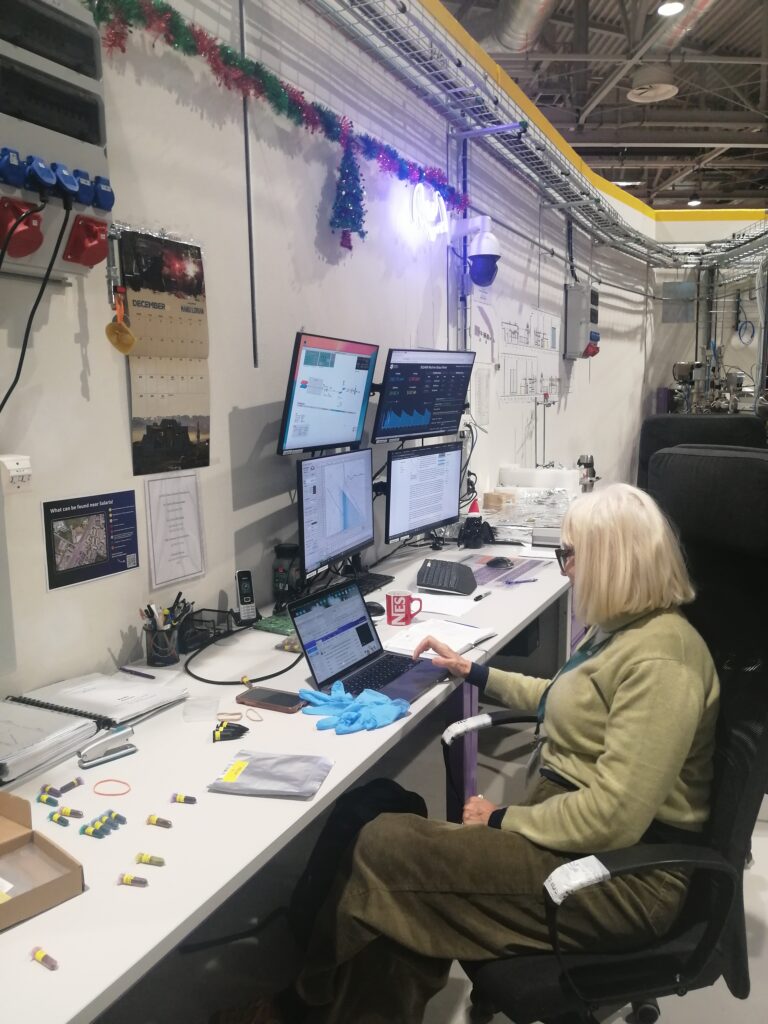
Teresa J. Bandosz at the ASTRA beamline
Excellence in Research Infrastructure and Scientific Support
A key strength of the NEPHEWS project lies not only in providing access to infrastructure but also in enabling close collaboration with highly skilled local teams.
„Thanks to the help of Solaris’s highly skilled and very professional instrument scientists from ASTRA and PIRX beamlines, we were exposed to a hands-on and quite unique experience of conducting cutting-edge experiments from which the fine details on the surface atoms could be derived.”
Although the data analysis is ongoing, the initial outcomes already demonstrate the strong potential of the conducted research.
„Even though right now we are at the early stages of the data analysis, the collected results seem very promising from both basic science and application viewpoints.”
For the visiting researchers, the experience at SOLARIS opened the door to long-term collaboration.
„It was our first time at Solaris and we certainly plan to further explore the possibility of scientific collaboration and exploration of this research infrastructure which brings unique experimental results. Moreover, we consider building and exploring an international and interdisciplinary research network as a true and efficient way to advance the society and address its needs.”
In parallel with the TNA-supported visit, SOLARIS also hosted an early-stage researcher from Greece under the NEPHEWS ESR Programme. This reflects the project’s strong emphasis on training, mobility, and capacity building for the next generation of scientists.
ESR participant: Georgios Charalampopoulos, PhD student, ICEHT–FORTH (Patras, Greece)
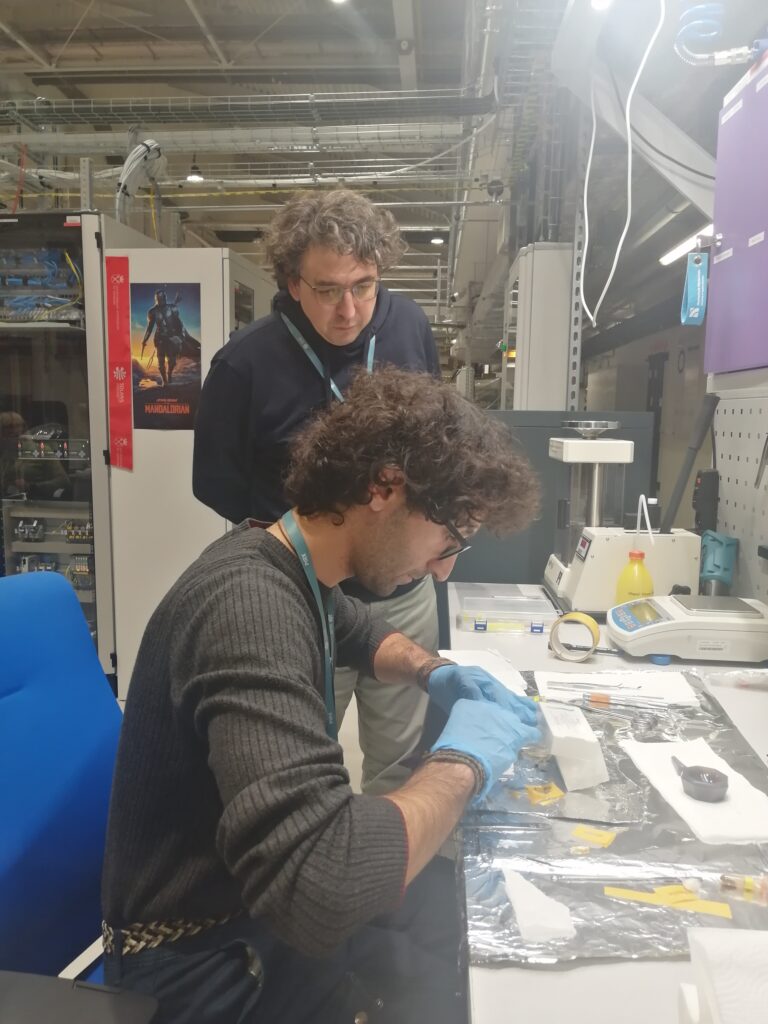
Marc Florent and Georgios Charalampopoulos at the ASTRA beamline
The ESR joined the on-site research team and took part in the experiments at the ASTRA and PIRX beamlines.
„I am a PhD student at ICEHT–FORTH. During my visit to SOLARIS under the NEPHEWS ESR programme, I mainly worked at the ASTRA beamline, where I was introduced to X-ray Absorption Spectroscopy (XAS), including XANES and EXAFS measurements.”
The visit provided direct involvement in real synchrotron experiments alongside experienced researchers.
„There, I actively assisted Prof. Teresa Bandosz and Dr. Marc Florent in the preparation, alignment, data acquisition, and on-site discussion of XAS measurements on carbon-based Fe and Cu catalysts with different N, O, and S coordination environments.”
A particularly valuable aspect of the ESR programme is hands-on participation and decision-making during beamtime.
„This visit provided my first hands-on experience with synchrotron experiments and allowed me to participate directly in real beamtime decision-making.”
The training component strongly contributed to the researcher’s scientific development.
„The most valuable aspect of the visit was the hands-on training in XAS data acquisition and interpretation. Equally important was the opportunity to interact with experienced researchers and learn from their practical expertise during measurements.”
The NEPHEWS ESR support played a crucial enabling role.
„The NEPHEWS ESR programme support was essential for my participation, as it covered travel and accommodation costs that would otherwise have made this visit impossible. Overall, the visit enhanced my understanding of synchrotron techniques.”
This visit to the SOLARIS clearly demonstrates the added value of the NEPHEWS project in practice. By enabling access to world-class research infrastructure, supporting both experienced and early-stage researchers, and fostering international and interdisciplinary collaboration, NEPHEWS contributes directly to scientific excellence, capacity building, and research addressing key societal challenges.