
The Early-Stage Researcher (ESR) programme within the NEPHEWS project offers young scientists a unique opportunity to gain hands-on experience at leading European research infrastructures. Designed to provide practical training at major photon and neutron facilities, the ESR programme gives early-career researchers access to advanced analytical environments, expert mentorship, and specialised techniques that are normally difficult to encounter at the beginning of a scientific career.
Participants of the first edition had the chance to complete a short-term internship at prestigious laboratories across Europe. One of the researchers, Natalia Manousi, affiliated with Aristotle University of Thessaloniki in Greece (currently affiliated with TU Wien, Austria), spent her placement at the Budapest Neutron Centre (BNC) – a key European hub for neutron-based research. We spoke with her about her experience during the stay.
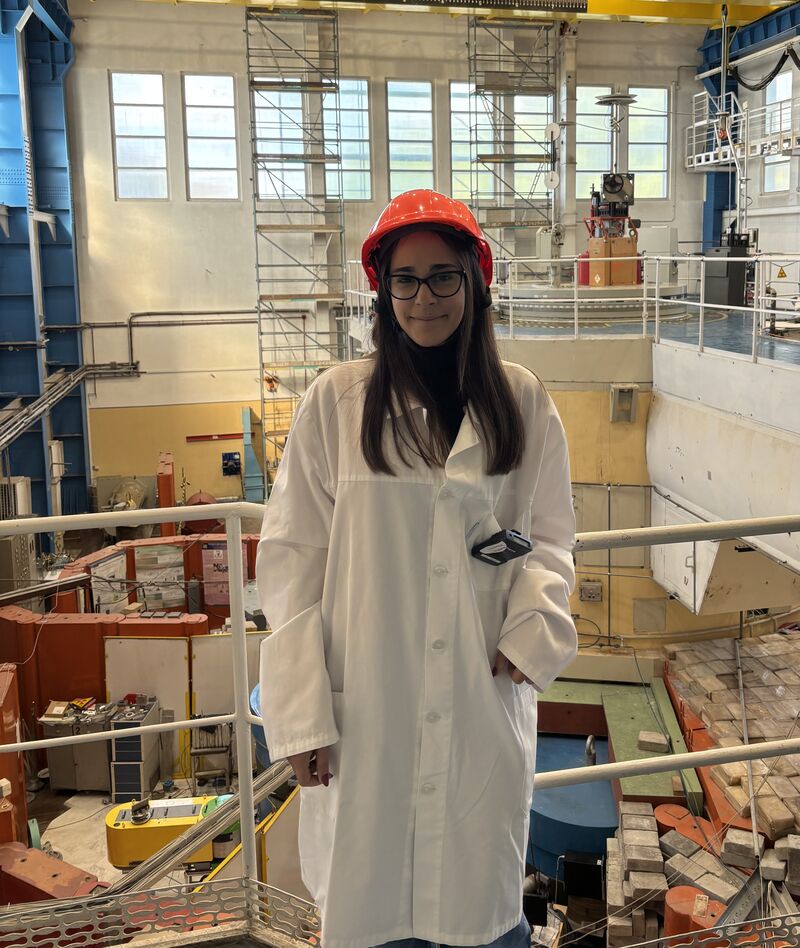
Natalia Manousi at BNC
I went to BNC between 13 and 17 October 2025. My visit and the training program were organized by Dr Belgya Tamás, to whom I am deeply thankful. The whole communication with Nephews and the Budapest Neutron Centre was very good from the first time I was notified that I will participate in the program. The staff of BNC supported me fully during the visit preparation and provided me with an excellent and very educative experience throughout my visit.
During these days I had the opportunity to learn the fundamental theory and the practical use of a wide range of techniques including:
As an analytical chemist, I was enthusiastic about the opportunities of the ESR programme to expand my expertise and acquire cutting-edge skills. In particular, I was eager to enhance my technical skills in advanced analytical techniques, particularly those involving neutron sources. Through my participation, I aimed to connect with leading researchers and fellow early-stage scientists, fostering collaborations. Moreover, I also wanted to build relationships within the scientific community is crucial for my career growth and future opportunities. By engaging in this program, I wanted to enhance my technical proficiency, expand my professional network, and position myself at the cutting edge of analytical chemistry research.
The most surprising aspect of working at the neutron facility was realizing how large-scale and complex the entire experimental ecosystem is compared with what can be seen in a typical university lab. The size of the instruments, the number of support systems (shielding, cooling, detectors, sample environments), and the level of coordination needed between engineers, technicians, and scientists became apparent only once being on site. Also, the level of security in BNC was truly surprising for someone coming from a university environment where you do not typically wear personal radiation monitors for the continuous measurement and documentation of gamma-ray radiation exposure.
In many of the aforementioned techniques I got the chance to gain hands-on experience and data processing. For example, in Mössbauer spectroscopy supervised by Zoltan Klencsár we performed the analysis of an unknown sample that turned out to be iron(II) sulfate heptahydrate (FeSO4*7H2O).
My collaboration with the BNC team was great from the very first moment. At the beginning of my visit Dr Belgya Tamás gave me a comprehensive overview of the techniques used in BNC and their research activities that served as a fantastic basis for my next steps. Throughout my visit, the scientists were always willing to explain practical aspects of the measurements, share their experience, and describe their work.
For most early-career researchers, large-scale infrastructures such as synchrotrons, free-electron lasers, and neutron sources are geographically distant, extremely expensive to build and operate, and heavily oversubscribed, so access is granted only through competitive proposal calls or specific programmes. As a result, many young scientists may work with data from these facilities without ever physically visiting them or seeing the full experimental environment on site, which limits their understanding of what is technically feasible and how experiments are really implemented. Seeing these instruments “with their own eyes” helps young researchers understand the full potential of such techniques. Moreover, I think that it is very important that NEPHEWS explicitly prioritizes researchers from selected widening countries and from states without their own large-scale research infrastructures, helping to reduce structural inequalities in access to high-end instruments which is very important as researchers from these countries do not typically get the opportunity to deepen their knowledge on such valuable techniques.

The experience shared by Natalia Manousi highlights the tangible value of the ESR programme within NEPHEWS. By offering direct access to advanced research infrastructures, the initiative helps young scientists gain essential practical skills, broaden their scientific horizons, and build international networks that will support their future careers.
Programmes like ESR demonstrate how strategic support and hands-on training can empower the next generation of researchers, ensuring that emerging talent from all regions of Europe can contribute to cutting-edge scientific discovery. If the experiences of Natalia Manousi are any indication, the impact of NEPHEWS will extend far beyond these short placements – shaping careers, strengthening collaborations, and promoting scientific excellence across borders.
Author: SOLARIS NEPHEWS TEAM