
My name is Isaac Appelquist Løge, and I am a postdoctoral researcher at NTNU and DTU. My research is focused on surface reactions, especially surface crystallization. I have had a long-standing wish to engage with large-scale experimental infrastructure, and through the NEPHEWS Twinning programme, I had the opportunity to join Professor Jinshan Pan’s group during their beamtime at the MAX IV Laboratory in Lund, on the HIPPIE beamline.
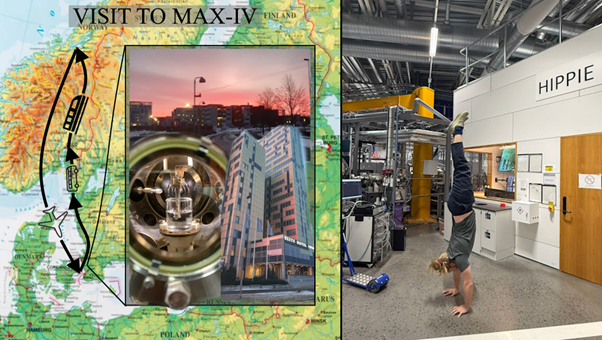
After completing the online safety training for Max-IV users, I flew to Denmark and arrived in time for an evening out with the group. We shared a meal, discussed, and planned the coming days of beamtime.
Over three days at HIPPIE, led by PhD student Erik Karpe and 4 others young researchers, we investigated the corrosion behaviour of aluminium alloys using ambient-pressure X-ray photoelectron spectroscopy (APXPS). Using a dip-and-pull approach, we monitored how the surface chemistry evolves as the sample is withdrawn from the electrolyte, leaving a thin liquid film on the surface. This provided insights into which alloying elements dissolve first, how oxide layers form, and how core-level binding energies shift during the early stages of corrosion.
For me, the visit was especially valuable for learning the practical side of running a beamline experiment, not only the measurements themselves, but also the “behind the scenes” work: experimental planning, choosing priorities with limited beamtime, coordinating people and resources, and making quick decisions during operation. I also gained a strong network of contacts that I hope will be important as I work towards leading and contributing to future beamtime proposals and experiments.
I am grateful to Professor Jinshan Pan and Erik Karpe for their guidance and for including me in the team, and to the HIPPIE beamline staff at MAX IV for their support throughout the measurements. I also thank the NEPHEWS project and the Twinning programme for making this training opportunity possible.