
Through the NEPHEWS Transnational Access (TNA) program, Dr. Jinhwan Byeon gained access to the SOLARIS National Synchrotron Radiation Centre, where he conducted in situ investigations of metal organic framework (MOF) materials under realistic EUV exposure conditions. Extreme ultraviolet (EUV) lithography is a cornerstone technology driving the continued miniaturization of semiconductor devices. However, developing photoresist materials that can withstand intense EUV exposure while enabling high resolution patterning remains a major scientific challenge.
Jinhwan Byeon, Ph.D., is a postdoctoral researcher in the Ameloot Group at KU Leuven/FWO. His research focuses on uncovering EUV reaction mechanisms in advanced functional materials. By leveraging state-of-the-art in situ techniques, he bridges fundamental materials science with real-world semiconductor industry
The project aimed to evaluate the reactivity of MOF materials under EUV radiation (13.5 nm wavelength) and to elucidate the chemical mechanisms triggered by exposure. This understanding is essential for designing next generation photoresists capable of supporting semiconductor fabrication at ever smaller feature sizes.
To achieve this, the team employed X-ray photoelectron spectroscopy (XPS) and near edge X-ray absorption fine structure (NEXAFS) spectroscopy to analyze the chemical structure and electronic states of the materials before and after EUV exposure. A key innovation was performing in situ EUV irradiation directly within the beamline chamber, followed immediately by spectroscopic characterization. This approach enabled direct observation of EUV induced chemical transformations under realistic conditions capabilities not achievable in conventional laboratory settings.
The experiments yielded significant insights. Zn L-edge NEXAFS confirmed the structure of the MOF materials, while XPS revealed clear cleavage of halogen carbon bonds under EUV exposure, providing molecular level understanding of the reaction pathways.
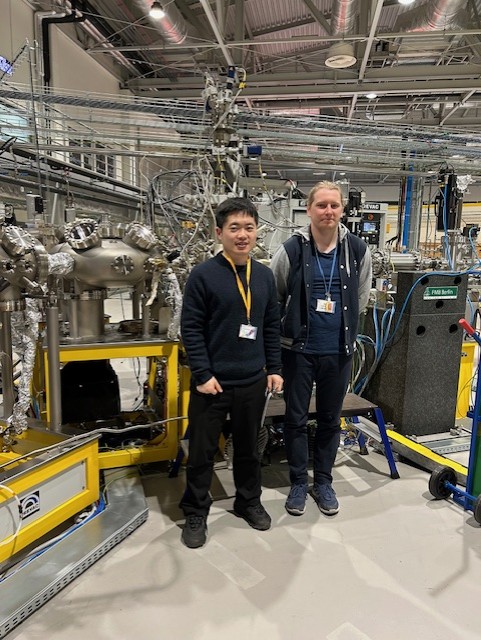
Reflecting on the impact of the facility, Dr. Byeon noted:
“Access to SOLARIS enabled in situ EUV exposure combined with advanced surface sensitive spectroscopies, which was previously inaccessible and significantly advances our understanding of EUV induced chemical reactions.”
These findings establish critical structure reactivity relationships that guide the rational design of next generation EUV photoresists. Building on these results, the team is preparing two scientific publications and has developed advanced material architectures for further study. Upcoming experiments will assess the EUV reactivity of these newly designed structures, accelerating the development of high-performance photoresists.
The NEPHEWS TNA program was instrumental in enabling this work. As Dr. Byeon emphasized:
“The travel and accommodation support made it possible for our team to carry out experiments that would otherwise have been inaccessible, allowing us to focus entirely on the science.”
This project highlights how NEPHEWS and SOLARIS together empower researchers to perform cutting-edge experiments at the forefront of EUV lithography materials science. By enabling in situ EUV spectroscopy studies, the program has directly advanced our understanding of EUV-induced chemistry in metal organic materials paving the way for innovative photoresist technologies essential to next generation semiconductor manufacturing.