
In June 2025, Daniela Santos, an early-career researcher from the University of Coimbra (Portugal), visited the ISIS Neutron and Muon Source (UK) through the Twinning Programme under the NEPHEWS project. This visit demonstrates how the Twinning Programme supports early-career scientists by providing access to leading research infrastructures, fostering international collaboration, and advancing scientific excellence across Europe.
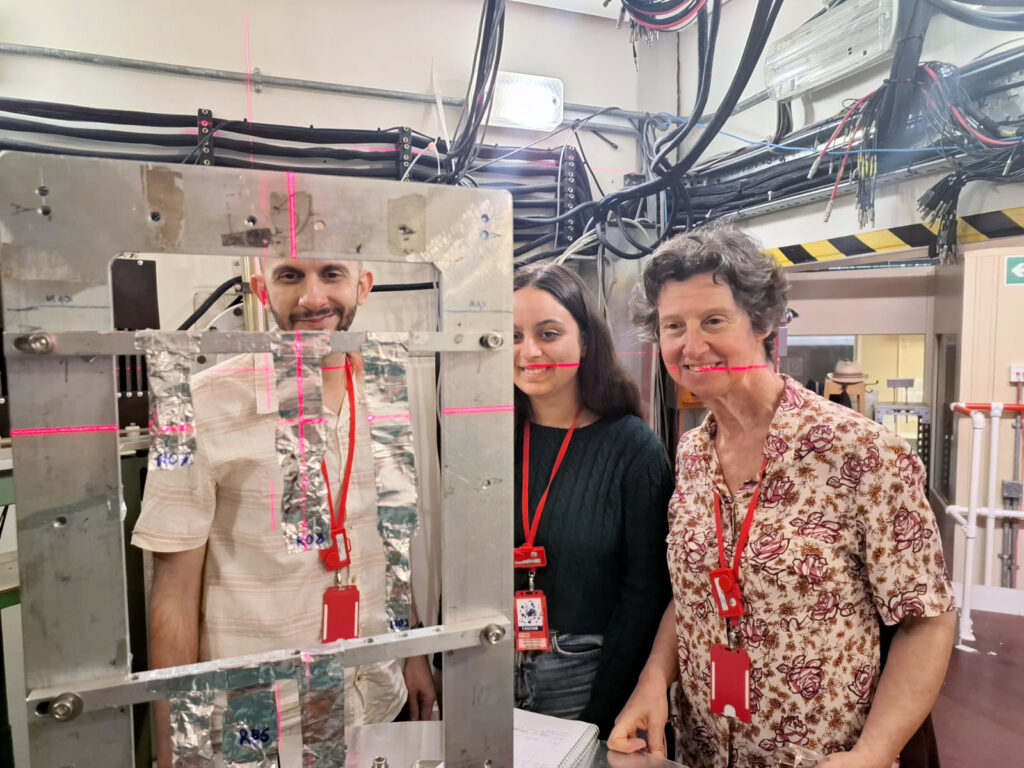
Daniela Santos (centre) during her visit to the ISIS Neutron and Muon Source
Daniela Santos is affiliated with the Department of Chemistry, Molecular Physical-Chemistry (QFM-UC), LAQV-REQUIMTE, at the University of Coimbra. At the time of her visit, she was completing a Master’s degree in Forensic Chemistry, focusing her thesis on the “Study of Burned Human Bones From Egyptian Mummies of the National Museum of Brazil.” Her research interests lie at the intersection of chemistry, cultural heritage, and forensic analysis.
Reflecting on her experience, Daniela described the importance of this opportunity at a pivotal moment in her academic journey:
„When I visited the ISIS facilities in June 2025, I was in the final stages of writing my thesis and completing my master’s degree in Forensic Chemistry. This visit was particularly meaningful to me, being both my first time in the United Kingdom and my first opportunity to travel as a student with the purpose of working in and further developing my skills at a leading research laboratory such as ISIS.”
During her stay at ISIS, Daniela worked with samples directly connected to her Master’s research. The visit allowed her to engage with advanced neutron-based techniques that significantly expanded the analytical depth of her study:
„The focus of my thesis was the study of skeletal remains from mummies belonging to the Egyptian Collection of the National Museum of the Federal University of Rio de Janeiro (Brazil) that were affected by the 2018 fire, and these were the samples I had the opportunity to analyse at ISIS.”
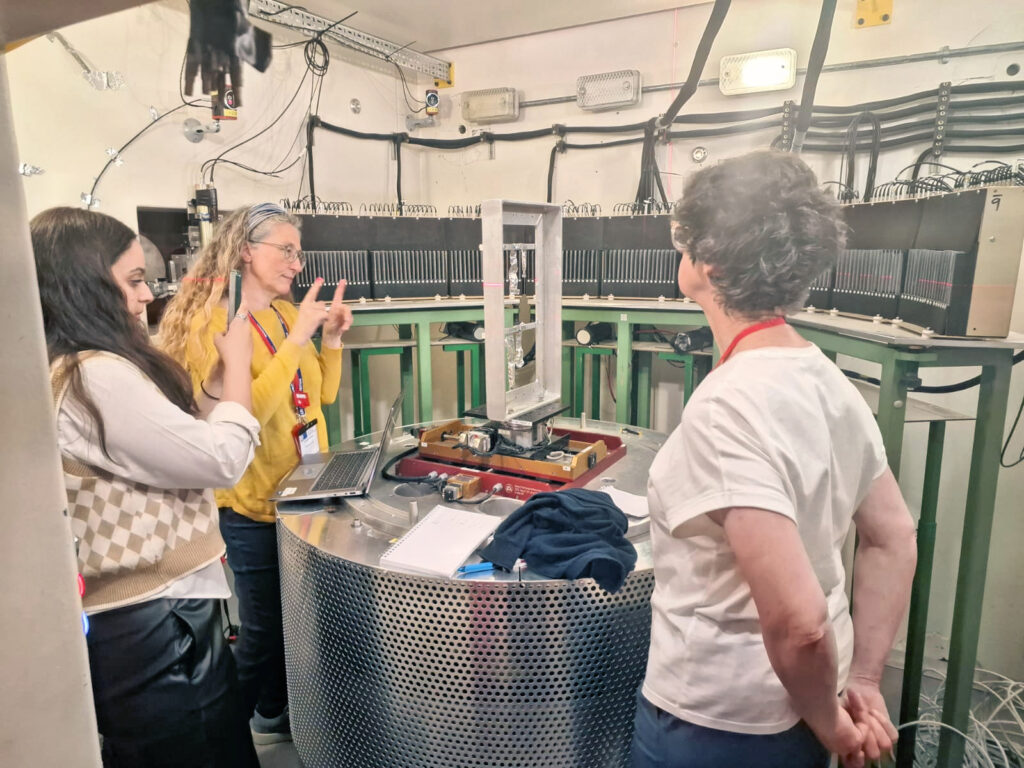
She followed experiments applying neutron diffraction and neutron resonance capture analysis (NRCA) on the INES instrument, complemented by neutron activation analysis (NAA). Daniela highlighted the scientific value of combining these methods:
„The samples had previously been analysed using neutron scattering, and the experiment I followed aimed to apply neutron diffraction and neutron resonance capture analysis (NRCA) using the INES. In addition, neutron activation analysis (NAA) was also performed. It was truly impressive to see how much information these complementary techniques are able to reveal.”
The Twinning Programme, supported by NEPHEWS, is specifically designed to facilitate hands-on engagement with large-scale research facilities, providing young scientists with exposure to cutting-edge instrumentation, expert mentoring, and international research environments. Daniela’s experience reflects the strong impact of this support on scientific training and professional development:
„I was deeply impressed by the work carried out at ISIS, and it was an honour to be able to observe and take part in this experience first-hand.”
She also expressed her gratitude to those who made the visit possible:
„I am sincerely grateful to my professors, who organised and led this study, Professor Dr. Luís Batista de Carvalho and Professor Dr. Maria Paula Marques, as well as to NEPHEWS for providing me with this unique opportunity.”
Daniela Santos’s visit stands as a strong example of how the Twinning Programme within NEPHEWS empowers emerging researchers, strengthens cross-border collaboration, and promotes innovative applications of neutron techniques in fields such as forensic science and cultural heritage research