
Unlocking Spin-Resolved Electronic Structure at SOLARIS
From 1 to 8 December 2025, the SOLARIS National Synchrotron Radiation Centre in Kraków Poland hosted scientists under the NEPHEWS TNA programme, which enables researchers to take advantage of world-class research infrastructures on site and carry out experiments at dedicated installations and beamlines. The stay of Raphaël Salazar and Jyoti Kaswan from NTC – University of West Bohemia, alongside Marcin Rozmus from ISMO, Université Paris-Saclay, clearly demonstrated the value of TNA schemes in exploring new ideas through experiments at cutting-edge facilities.
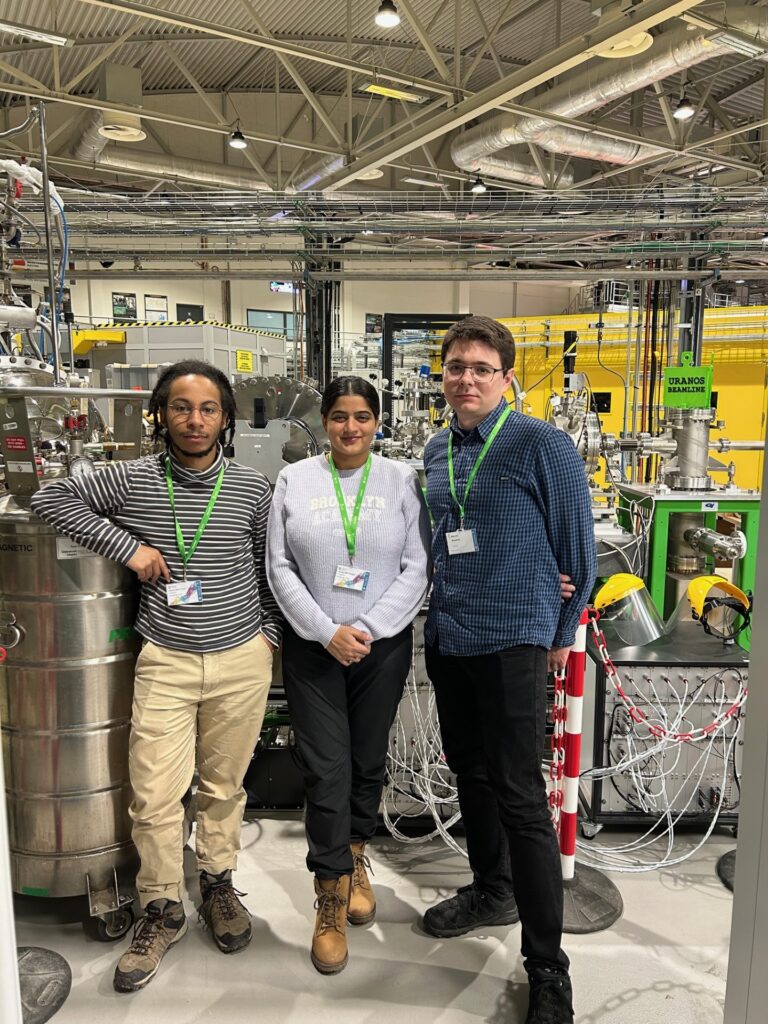
Raphaël Salazar, Jyoti Kaswan and Marcin Rozmus at Solaris
Advanced quantum materials research often requires experimental capabilities that go beyond laboratory techniques. During a research visit supported by the TNA NEPHEWS program, spin- and angle-resolved photoemission spectroscopy (spin-ARPES) measurements were successfully performed at the URANOS beamline of the SOLARIS National Synchrotron Radiation Centre, enabling direct access to the spin-dependent electronic structure of intercalated NbS₂.
The experiment focused on probing low-energy electronic states with spin resolution, with the goal of identifying signatures of predicted altermagnetism. Access to synchrotron radiation at SOLARIS was essential for achieving the required energy, momentum, and spin resolution, which cannot be obtained with laboratory-based techniques- says Marcin Rosmushighlighting the critical role of SOLARIS infrastructure in enabling cutting-edge condensed matter research.
A key strength of the URANOS beamline is its stable and flexible experimental setup, including two orthogonally mounted 3D VLEED Ferrum spin detectors, which allow efficient spin-resolved measurements and comprehensive momentum-space mapping. While the experiment required careful alignment and optimization – particularly to maintain optimal signal quality- the measurements progressed reliably under stable beamline conditions.
A defining moment of the beamtime came when a clear spin-polarized signal was observed in the photoemission spectrum for the first time. This milestone confirmed the feasibility of the experimental approach and resulted in the acquisition of consistent, high-quality spin-resolved datasets suitable for quantitative analysis and comparison with theoretical models.
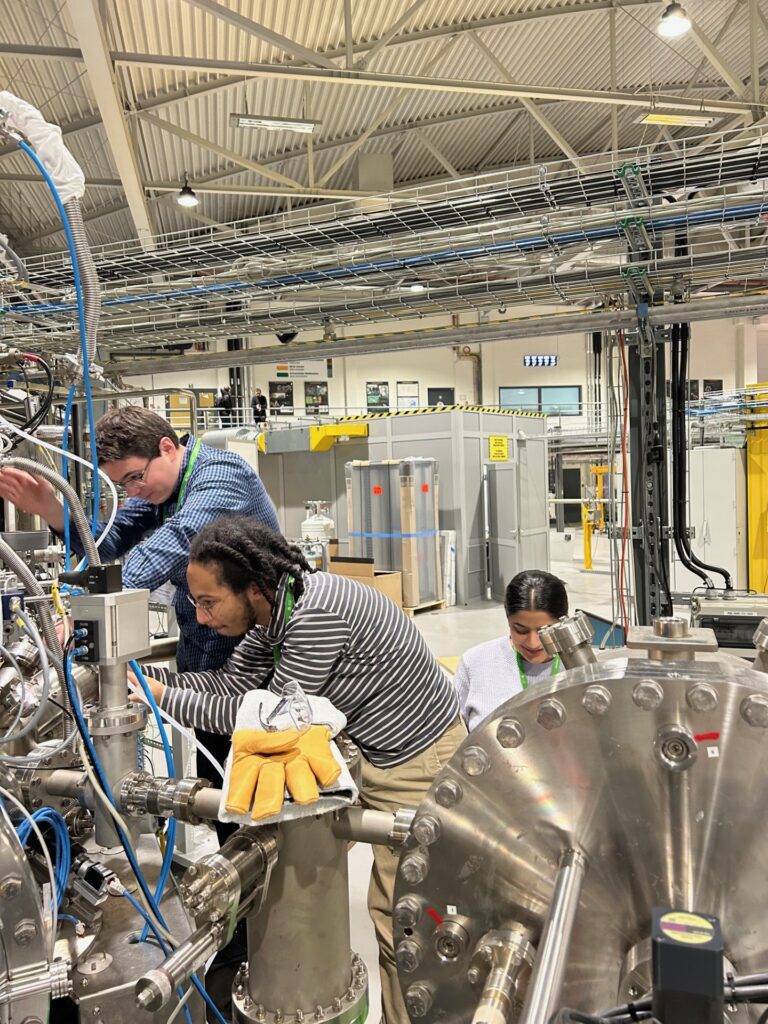
Marcin Rozmus, Raphaël Salazar and Jyoti Kaswan at URANOS beamline
“This was my first spin-resolved ARPES experiment and seeing the spin polarization appear in the spectrum after many hours of alignment and optimization was an unforgettable moment. The stability and flexibility of the URANOS beamline made it possible to carry out measurements that would be impossible in a laboratory setting, and the support from the SOLARIS staff was outstanding throughout the entire beamtime.”- says Jyoti Kaswan.
The data obtained at SOLARIS now form the basis for detailed analysis, preparation of scientific publications, and potential follow-up experiments. Beyond the scientific results, the visit demonstrated the value of user access to advanced synchrotron techniques and expert technical support.
The TNA NEPHEWS program significantly simplified the logistics of the visit by covering travel and accommodation. Throughout the beamtime, the SOLARIS staff provided efficient technical support and a well-organized working environment – says Marcin Rosmus